Honda V3R 900 E-Compressor Prototype – an electric motor drives the compressor
Honda is developing a motorcycle engine with an electrically driven compressor: the compressor is spun by an electric motor, not by the exhaust gas and not by the crankshaft. Honda showed the technology on the V3R 900 E-Compressor Prototype, a V3 with 900 cm³. Here you will find what Honda has announced so far, how the E-Compressor works and what the patents show – as of 25 October 2026.
1Prototype
From the 2024 V3 concept to the 2025 V3R 900 E-Compressor Prototype
Honda V3R900: what Honda showed at EICMA
Water-cooled V3 with a 75-degree cylinder angle
At EICMA in Milan on 5 November 2024, Honda presented a newly developed, water-cooled V3 engine with a 75-degree cylinder angle. According to Honda, it is the first motorcycle engine with an electric compressor; Honda did not state a displacement at the time.
On 4 November 2025, the ready-to-ride V3R 900 E-Compressor Prototype with 900 cm³ followed at EICMA. Honda is aiming for performance comparable to a 1,200 cm³ engine – a development target, not a measured figure.
Honda has not yet published power, torque, weight or price (as of 25 October 2026).
FAQ prototype
Frequently asked questions about the Honda V3R900
A Honda prototype: a water-cooled V3 with a 75-degree cylinder angle, 900 cm³ and an electrically driven compressor. Honda showed it on 4 November 2025 at EICMA in Milan as the V3R 900 E-Compressor Prototype.
The prototype has 900 cm³. Honda is aiming for performance comparable to a 1,200 cm³ engine.
Honda has not yet published any performance figures (as of 25 October 2026).
2How it works
An electric motor spins the compressor
How the Honda E-Compressor works
Boost pressure independent of engine speed
A supercharger compresses the intake air before it flows into the cylinders. More air in the combustion chamber allows more fuel and therefore more power from the same displacement. In the Honda E-Compressor, an electric motor spins the compressor wheel. According to Honda, this allows boost pressure to be controlled independently of engine speed, and the engine delivers torque responsively even at low revs.
Honda can position the electric compressor freely within the tight space of a motorcycle and uses this to centralise mass. According to Honda, it does not need charge-air cooling. In an interview in May 2026, a Honda representative confirmed that the prototype carries its own battery for the compressor; he did not state its voltage or capacity.
FAQ how it works
Frequently asked questions about the Honda E-Compressor
An electrically driven compressor: an electric motor spins the compressor wheel and forces more air into the engine. Honda shows it on the V3R 900 E-Compressor Prototype, a water-cooled V3 with a 75-degree cylinder angle.
Yes, according to a Honda representative, the prototype has its own battery for the compressor. Honda has not published its voltage or capacity.
According to Honda, the E-Compressor does not require charge-air cooling.
3E-Compressor and turbo
What drives the compressor
Why Honda drives the compressor of the V3R900 electrically
Exhaust gas, crankshaft or electric motor
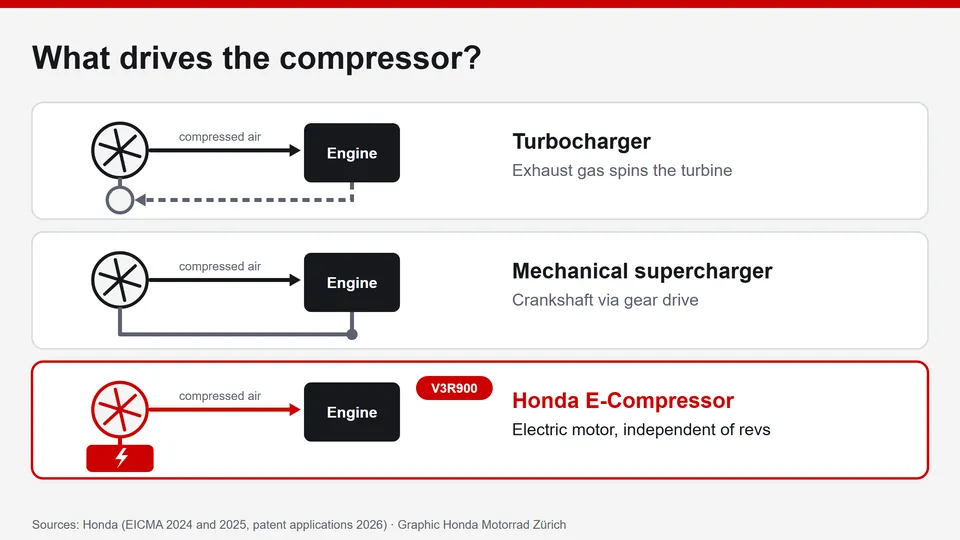
- Turbocharger: the exhaust gas drives a turbine, which spins the compressor via a shaft. Boost pressure depends on the volume of exhaust gas – and at low engine speed there is little exhaust gas.
- Mechanical supercharger: the crankshaft drives the compressor via a gear drive; its speed is tied directly to engine speed.
- Honda E-Compressor: an electric motor drives the compressor, without exhaust gas and without any connection to the crankshaft.
In cars, electrically driven compressors have been in series production since 2016. Honda's claim to be the first to use an electric compressor therefore applies explicitly to motorcycles.
FAQ E-Compressor and turbo
Frequently asked questions about the difference
No. A turbocharger is driven by the exhaust gas, the E-Compressor by an electric motor. According to the patent applications, Honda's compressor uses neither exhaust energy nor engine power.
For motorcycles, yes, according to Honda. In cars, electrically driven compressors have existed since 2016.
4Patents
Nine applications, published on 4 June 2026
What the patents on the Honda E-Compressor show
Supercharger with electric motor, naturally aspirated mode and control by riding state
On 4 June 2026, nine international patent applications from Honda were published; the original Japanese filings date from 27 to 29 November 2024. They describe a supercharger driven by an electric motor that uses neither exhaust energy nor engine power. In addition, they cover:
- a bypass duct from the air filter directly to the plenum chamber, through which the engine runs without boost – a valve selects between naturally aspirated and boosted operation,
- control of the supercharger according to engine and riding state and to the rider's demand for acceleration,
- versions for V engines with two to six cylinders and for inline engines.
Patents show what a manufacturer is working on. They are not an announcement of production models.
FAQ patents
Frequently asked questions about the Honda patents
On 4 June 2026, nine international patent applications from Honda were published. They describe a supercharger with an electric motor, a bypass duct for naturally aspirated operation, control according to riding state and versions for V engines with two to six cylinders as well as for inline engines.
5CX500 Turbo
Honda and forced induction since 1982
Honda CX500 Turbo and CX650 Turbo: the idea is not new
More power from less displacement
In 1982 the Honda CX500 Turbo came onto the market, followed in 1983 by the CX650 Turbo. The aim back then was the same as with the V3R900: the power of a larger engine from less displacement. The difference lies in the drive – on the CX500 Turbo the exhaust gas drove the compressor, on the V3R900 it is an electric motor.
FAQ CX500 Turbo
Frequently asked questions about the history
Yes: the CX500 Turbo came in 1982, the CX650 Turbo in 1983. Back then the exhaust gas drove the compressor; on the V3R900 it is an electric motor.
6Market launch
As of 25 October 2026
When is the Honda V3R900 coming?
Development towards production, Europe first
According to Honda, development of the V3R is continuing towards series production. In May 2026, a Honda representative said in an interview that the company wants to bring the V3R to market in this form, and in Europe first.
As of 25 October 2026, there is no official production model, no date and no technical data. The next opportunity is EICMA 2026 in Milan from 3 to 8 November 2026. As soon as Honda Switzerland announces specifications and price, you will find them on this page.
Honda technology you can ride today: the Honda E-Clutch and Honda DCT. The overview Honda models shows all current models, and you can try them on a motorcycle test ride.
FAQ market launch
Frequently asked questions about launch date and price
Honda has not announced a date (as of 25 October 2026). According to an interview from May 2026, Europe is to come first.
There is no price yet. As soon as Honda Switzerland announces it, it will appear on this page.
Honda new models in Zurich – our catchment area
Honda Motorrad Zürich in Volketswil ZH keeps you informed about new Honda models and technology such as the V3R900 E-Compressor and offers the current Honda motorcycles with E-Clutch and DCT throughout the entire catchment area: Zürich, Winterthur, Volketswil, Uster, Kloten, Dübendorf, Wetzikon, Wallisellen, Bülach, Effretikon, Bassersdorf, Regensdorf, Baden, Brugg, Zug, Rapperswil-Jona, Einsiedeln, Frauenfeld, Wil SG and Schaffhausen as well as the cantons of Zurich, Aargau, Zug, Schaffhausen and Thurgau.